
So, a few things to remind everybody. First of all, don’t forget EHRs (electronic health records) were purpose built originally for billing. This is no secret. People quite openly have called EHR systems glorified cash registers. If I want to be generous, maybe I would restate this to say that EHRs were designed to document patient interactions. This is what their core architecture was built to achieve.
But today, there’s a lot that goes on that isn’t a traditional patient interaction. First of all, me even calling it, frankly, a patient interaction should give longtime listeners a clue where this is headed. I mean, say you’re sitting at home on your couch. I don’t know. You’re probably not considering yourself a patient. You’re considering yourself a person sitting on your couch.
However, say you’re sitting on your couch and you haven’t taken your COPD maintenance therapy. Potentially that is something of clinical significance that maybe should get figured out and noted somewhere—potentially prior to the acute event going down.
Or, still talking about things that are relevant to patient health but which don’t naturally tuck into an EHR system’s native architecture, maybe we have social workers and nutritionists and all kinds of people who are not doctors or nurses or PAs (physician assistants) in this mix. Most of the time, these people don’t even have access to the EHR. I mean, what percentage of things that are going to impact a person’s health outcomes can be classified as traditional patient encounters that EHRs were designed to document? I mean, you’ve got your scheduler who wants to tell the transportation company something about a patient. Anything RPM. Where’s the caregiver or the family in that garden-variety patient interaction?
In sum, what is happening between codes getting written in patient health records? Where’s all that information going? I mean, what order set are you gonna use to get all that in and out of the system?
Am I saying anything revolutionary that many of you don’t already know extremely well? No, I am not. But I am shining the spotlight on it to challenge what might have become a sort of default position at provider organizations today, which is to make the EHR the one ring to rule them all, which might be something to consider revising strategically.
My guest in this healthcare podcast, Emily Kagan Trenchard, makes a super point about all of this that I haven’t heard made so succinctly or so eloquently. Emily puts it this way: She says just integrating into the EHR as a reflex without contemplation is kind of the olden days. She talks about identifying the core functionalities, the centers of gravity that are needed to bring together providers and patients and everybody else in the mix. Then you find the best systems—call them platforms if you want. But if, at a fundamental level, you have a technology designed for one thing and you’re trying to shoehorn it to do something else and this something else is a critical business function, maybe this is something to think about at the highest levels.
Of course, it goes without saying that these platforms have to work together (obviously); but you kind of gotta get the right platform for the right job.
Now, to make one point clear as glass, what we are not talking about here is cobbling together a bunch of point solutions. What we are talking about is getting the fundamentals, the core architecture here, solidified. Pam Arora talks about this at length in episode 246. She’s the CIO at Texas Children’s. Pam Arora says that if a health system doesn’t get its technology infrastructure rock solid, if that infrastructure is janky in any way, then everything built on top of it will require duct tape and workarounds and probably not go as well as planned.
On the show today, Emily Kagan Trenchard continues that theme. She talks about the four platforms that she feels are very necessary to underpin or be the chassis to best support helping providers and others help patients and people in and out of the clinic. She calls each platform a tentpole. These four platforms are:
The EHR
A CRM (customer relationship manager). And, by the way, when Emily says CRM, she’s talking about more than software. It’s more like a philosophy or a whole approach around relationship building with patients/people/customers.
A cloud platform for data and analytics
A data exchange
One last takeaway, for me at least. Emily has talked about two basic facts that inform her thinking: (1) Providers and patients alike are increasingly not tolerant of friction. (2) What is easiest is the most likely to happen.
Something that we don’t get into in this show but certainly bears considering is the larger context here. Yeah, we got Amazon, we got Google—not only what they are doing alone but also what they are investing in. They have platforms that are purpose built to remove friction and to be really, really easy … one-click easy.
So, let’s talk about the WIIFM (the “what’s in it for me?”) here for health systems to get a move on. When Merrill Goozner was on the show a few weeks ago (EP388), he says that when patients and employers and taxpayers start crying uncle on both healthcare prices as well as just bad friction-filled experiences and also when, at the same time, technology and new competitors move in on the supply side, he says what’s gonna happen then is older incumbents like hospitals could find themselves getting their lunches eaten. So, probably intuitively as well as intellectually, health systems really getting their technology clearly optimized to support their communities, their patients, and their providers might seem to be mission critical, especially as we contemplate the stuff that Mike Thompson was talking about in episode 389 about how there is increasingly data out there which identifies hospitals who are very inefficiently run.
And so, if at a very basic level a hospital has misaligned tech that’s requiring a lot of workarounds and stuff, which is another way to say wasting a lot of staff time, having the right technology deployed in the right way will certainly ground efforts to be effective and also help compete with some of these lurking entities who are looking to take a piece of the $3 or $4 trillion healthcare industry in this country—of which hospitals account for something like $1 trillion. And as Eric Bricker, MD, says in episode 351, this is why hospitals have a big red target on their back.
Also, I would be remiss not to mention that non–purpose-built, dare I say bad, technology causes bad clinician burnout, which causes bad turnover, which is really expensive. Arshad Rahim, MD, MBA, FACP, talks about this in episode 323.
By the way, I interviewed Emily Kagan Trenchard at NODE.Health’s Annual Digital Medicine Conference in New York City this past December—always a great conference. Emily is SVP and chief of consumer digital solutions over at Northwell Health. Northwell, in case you haven’t heard of this health system, is very large: 21 hospitals, 850 outpatient clinics, 300,000 patients a year. Yeah, it’s big.
You can learn more at northwell.edu and connect with Emily on LinkedIn.
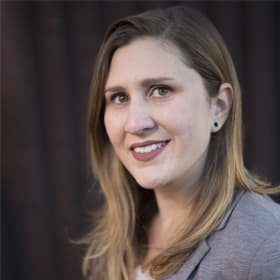
Emily Kagan Trenchard offers a unique perspective from within the American medical system: A spoken-word-poet-turned-healthcare-executive, she is on a mission to remix the human in healthcare, challenging entrenched assumptions about what it means to give and receive care in the digital age.
As senior vice president, chief of consumer digital solutions, for New York State’s largest health system, Northwell Health, Emily leads teams that push the limits of how we use technology to make healthcare seamless and steeped in humanity while keeping the company competitive at a time of radical change. She is a big believer that innovation is an ongoing process, not just a box to check, and launched Northwell’s first UX department to ensure that patient perspectives and needs drove the design of digital tools and systems.
Prior to joining Northwell, Emily led Web systems for New York City’s Lenox Hill Hospital, where she drove the development of many early consumer health tools, including the first-ever implementation of the Zocdoc scheduling platform for a hospital.
Emily holds a master’s degree in science writing from Massachusetts Institute of Technology and a bachelor’s degree from the University of California at Berkeley.
07:55 How does customer digital solutions fit into the larger technology infrastructure in healthcare?
09:54 “Where else do you have centers of gravity that you should respect in the architecture?”
10:11 “There is a constellation of need here.”
11:51 “We interact with way more than just patients.”
14:28 “We have to be able to understand the network of relationships in a population.”
15:11 How do EHRs and CRMs interact as two tentpoles in healthcare?
17:32 “The question is, where does a human being work?”
19:54 How are patients staying on a nonfragmented care journey in a proactive way?
23:46 “Anybody who’s a consumer of our digital offerings has a relationship with us.”
29:33 “The medicine is being practiced not only on our physical bodies but on our digital bodies.”
You can learn more at northwell.edu and connect with Emily on LinkedIn.
Recent past interviews:
Click a guest’s name for their latest RHV episode!
Dr Scott Conard, Gloria Sachdev and Chris Skisak, Mike Thompson, Dr Rishi Wadhera (Encore! EP326), Ge Bai (Encore! EP356), Dave Dierk and Stacey Richter (INBW37), Merrill Goozner, Betsy Seals (EP387), Stacey Richter (INBW36), Dr Eric Bricker (Encore! EP351), Al Lewis, Dan Mendelson, Wendell Potter, Nick Stefanizzi, Brian Klepper (Encore! EP335), Dr Aaron Mitchell (EP382), Karen Root, Mark Miller, AJ Loiacono, Josh LaRosa, Stacey Richter (INBW35), Rebecca Etz (Encore! EP295), Olivia Webb (Encore! EP337), Mike Baldzicki, Lisa Bari, Betsy Seals (EP375), Dave Chase, Cora Opsahl (EP373)